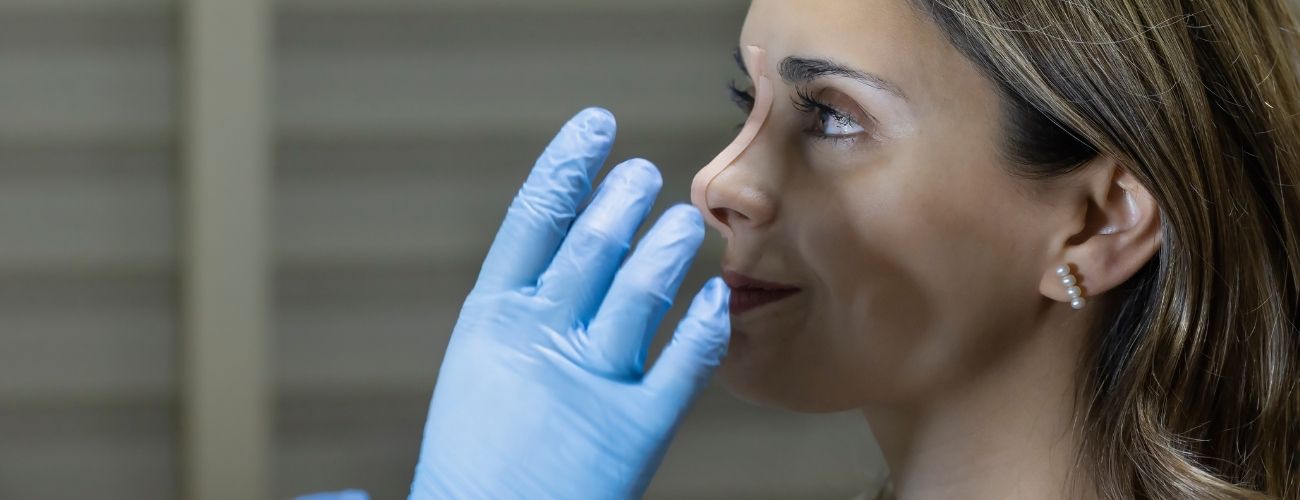
Caucasian nose morphology is a distinctive nasal type characterized by a prominent dorsal hump, a strong bony and cartilaginous framework, thin skin, and a nasal tip that often tends to droop downward. As one of the clearest reflections of geographic and genetic heritage, this anatomy is considered within the scope of ethnic rhinoplasty and typically requires tissue-preserving techniques and millimetric precision beyond standard approaches. Due to its high bony vault and relatively narrow airways, this form may involve functional breathing problems as well as aesthetic concerns. It represents one of the most challenging groups to plan surgically—yet also one of the most striking in terms of potential results—because it is refined without disrupting the face’s characteristic expression.
İçindekiler
What is a Caucasian nose, and what are its distinguishing features?
That characteristic profile you imagine when you hear “Caucasian nose” is, in fact, the product of centuries of adaptation. These noses are often more dominant, more projecting, and supported by a notably strong bony structure compared with other facial features. In medical literature, they are sometimes described as sharing similarities with an “aquiline” or Roman nose, yet the Caucasian nose has more specific and distinctive details.
As a physician, the first element I focus on is the height of the nasal dorsum. This height is not merely a simple hump issue; it is a convex prominence formed at the junction of bone and cartilage that creates a clearly visible curve in profile. However, the issue is not limited to the hump. The nasal tip may be relatively weaker compared with the powerful dorsum or may have a tendency to droop. Complaints about the tip being pulled toward the upper lip—especially while smiling—are common in patients with this nose type.
The most prominent physical features of this nose type include:
- High nasal dorsum
- Distinct bony hump
- Long nasal length
- Drooping nasal tip
- Thin skin
- Strong cartilaginous tissue
- Narrow nasal alae
When these features come together, they present both an advantage and significant risks for the surgeon. It is an advantage because there is typically abundant, strong cartilage available to shape. It is a risk because thin skin does not forgive even the smallest mistake—any minor irregularity can become visible on the surface.
What does the philosophy of ethnic rhinoplasty mean for a Caucasian nose?
The era of “one-size-fits-all” noses in rhinoplasty is long over. Older operations that produced identical-looking outcomes—over-rotated tips and overly scooped dorsums—have given way to an approach that is “customized” and “ethnicity-preserving.” Although ethnic rhinoplasty is often associated with Asian or African noses, the Caucasian nose is also a special group that should be evaluated within this category.
In individuals with Caucasian facial features, the face is usually more angular and skeletal: cheekbones are prominent, the jawline is strong, and the forehead is broader. Creating an overly small, excessively curved, doll-like nose on such a face is aesthetically disastrous, because no matter how well executed, it will look foreign to that face. Our goal is to soften a strong expression—but never erase it. The word “refine” is the most accurate description here. The hump may need to be reduced and the tip refined, but the nose’s strong relationship with the face must not be severed.
In this philosophy, our core principle is that after surgery, the patient should not see someone else in the mirror—but their best version. Achieving a result that looks as though it has always belonged there, without disrupting natural facial proportions, is the pinnacle of Caucasian nose surgery. This is only possible by focusing not on making the nose smaller, but on balancing it with the face.
How does thin skin make surgery more difficult?
Perhaps the most critical and demanding feature of many Caucasian noses—the point where surgical mastery is tested most—is the skin quality. In these patients, the skin is generally thin. I often describe thin skin to patients as a “silk sheet” or “satin cover”: whatever lies underneath is reflected to the surface as-is. In thick-skinned patients, the skin can camouflage minor bony irregularities. In thin-skinned Caucasian noses, we do not have that margin for error.
Millimetric steps performed on the bony and cartilaginous framework—shaving, smoothing, or cuts—can become clearly visible once healing is complete. If a pinhead-sized bump or roughness remains on the bone, thin skin will reveal it immediately. This obligates the surgeon to work flawlessly and to leave the bony surface as smooth as glass.
The main surgical challenges associated with this skin type include:
- High visibility of skeletal details
- Requirement for an ultra-smooth surface
- Risk of graft visibility
- Need for camouflage
- Delicate tissue manipulation
- Proneness to bruising
However, thin skin also offers an important advantage: postoperative swelling resolves more quickly, and the new shape, contours, and light-reflection effects become apparent much earlier. While thick-skinned patients may wait months for definition, thin-skinned patients often see refined results sooner. To harness this advantage safely, we may use “camouflage techniques,” such as crushed cartilage pieces or fascial layers to cover the dorsum and tip. These act like a soft cushion under the skin, creating a natural feel and preventing sharp edges from appearing overly harsh.
Why is breathing function as critical as aesthetics?
Patients typically come to us saying, “I don’t like the shape of my nose.” Yet after a detailed examination, we find that nearly all individuals with a Caucasian nose also have significant breathing issues. This is not surprising: what you see externally—deviation, hump, asymmetry—is often just the visible part of the iceberg. The more irregular the outside, the more likely the inside is also irregular.
The septum—the bony and cartilaginous wall that divides the nasal cavity—often shows marked deviation in Caucasian noses. Additionally, long-term airflow disturbance frequently leads to turbinate enlargement. As an ENT specialist, my first rule is simple: a nose that cannot breathe is a failed surgery, even if it looks beautiful.
Rhinoplasty has the potential to narrow the airways. If you attempt to reduce a nose that is already narrow internally or significantly deviated—purely for aesthetics—you can make breathing extremely difficult. For this reason, our procedure is always “septorhinoplasty”: in the same session, we correct the deviation, open the airways, address the turbinates if needed, and perform aesthetic reshaping.
Key factors that influence respiratory function include:
- Septal deviation
- Turbinate hypertrophy
- Nasal valve narrowing
- Mucosal adhesions
- Allergic reactions
Why is Piezo surgery indispensable in Caucasian nose operations?
The bony framework of Caucasian noses is often harder, thicker, and stronger than in many other nose types. With traditional methods, tools such as chisels, hammers, and rasps could sometimes lead to uncontrolled fractures, even with careful technique. Moreover, this mechanical trauma could injure surrounding soft tissues, vessels, and nerves, causing significant bruising and swelling after surgery.
This is precisely where Piezo (ultrasonic) rhinoplasty becomes one of the most valuable technological advances. Piezo devices operate using ultrasonic vibrations and selectively act on mineralized tissue—bone. When the tip contacts bone, it cuts and shapes it with high precision; if it touches skin, mucosa, vessels, or nerves, it does not injure them in the same way.
In cases with dense bone and thin skin—where bony smoothness is absolutely critical—Piezo is not a luxury but almost a necessity. It allows us to work like a sculptor with millimetric control while reducing the hump or narrowing the nose. Because we shape by controlled cutting rather than fracturing, patients experience significantly less trauma during recovery.
Concrete benefits of Piezo technology include:
- Millimetric cutting precision
- Soft-tissue preservation
- Less bruising
- Less swelling
- Faster recovery
- Controlled bone contouring
- Smoother bony surface
How are the nasal roof and function preserved when reducing a hump?
Correcting a humped Caucasian nose may look, from the outside, like simply shaving down a protrusion. Anatomically, however, it is a complex process. The structure forming the hump is the nasal roof. If you remove this roof in an uncontrolled manner, you risk compromising the narrowest functional airway area, the internal nasal valve. Additionally, a nose with an inadequately reconstructed roof may collapse over time and develop aesthetic issues such as the “inverted V deformity,” with visible shadowing along the dorsum.
To eliminate these risks, we use a modern technique called “component dorsal reduction.” Instead of removing bone and cartilage as a single block, we treat them as separate components. After hump reduction, we reconstruct and strengthen the nasal roof using “spreader grafts.”
These cartilage strips act like beams placed between the roof and the sidewalls. They help prevent collapse and widen the midline airway, allowing the patient to breathe more comfortably. In other words, while performing an aesthetic maneuver, we can increase mechanical stability as well. This helps prevent long-term narrowing or collapse and supports a smooth dorsum that reflects light naturally.
How is a drooping nasal tip solved permanently?
Another vulnerable point of many Caucasian noses is the tip. Even if the dorsum is strong, the tip cartilage can be comparatively weak or insufficiently supported. With gravity and aging, the tip is prone to drooping. Elevating the tip using sutures alone can be temporary, and the tip may descend again over time.
For a lasting and aesthetic tip, “structural grafting” is essential. Fortunately, Caucasian noses often contain a substantial and strong septal cartilage reserve. During surgery, we do not discard the valuable cartilage removed while correcting the deviation; we reshape it and place it as a strong support (a strut graft) for the tip.
This support functions like the central pole of a tent, holding the tip in an upright and ideal position. When we also release the muscles that pull the tip downward during smiling, the tip maintains its position both dynamically and at rest. Because we use the patient’s own tissue, there is no rejection risk, and the result is durable over the long term.
What is especially important during facial harmony analysis?
In aesthetic surgery, success is found not in isolated details but in the overall picture. A surgery planned by focusing only on the nose can disturb facial harmony. When analyzing a Caucasian facial type, we evaluate the nose in relation to its neighbors. One common finding is “micrognathia,” meaning a retruded chin.
When the chin is retruded, the nose is perceived as larger and more projected than it truly is. If we reduce only the nose, the profile can shift toward a bird-like appearance. Therefore, the forehead, nose, and chin must be assessed as a unified profile system. In some patients, adding fat grafting or an implant to the chin during the same session can make the nose appear far more refined.
Key parameters in facial analysis include:
- Forehead–nose transition angle
- Nose–lip angle
- Chin position
- Cheekbone width
- Intercanthal distance
- Vertical facial proportions
Why might revision surgery be needed in Caucasian noses?
Primary rhinoplasty on a Caucasian nose can have a high success rate when performed with correct techniques and adequate experience. However, revision (corrective) surgery may become necessary due to insufficient cartilage support, uncontrolled bone removal, infection, or other factors.
The greatest challenge in revision surgery for Caucasian noses is often “material shortage.” If the valuable septal cartilage has already been used or discarded in the first operation, there may be insufficient cartilage left to rebuild the nose. If the roof has collapsed or the tip has dropped, strong support is required. In many cases, ear cartilage may be too soft and inadequate.
In such difficult cases, “rib cartilage” (costal cartilage) can be lifesaving. A small piece of cartilage harvested from the patient’s rib can be carved and used to reconstruct missing structural elements—much like craftsmanship in woodworking. While it may sound intimidating, modern techniques make this process quite comfortable. Revision rhinoplasty is a strategic and highly experience-dependent process—often compared to playing chess.
What is the postoperative recovery like, and how comfortable is it for the patient?
With advances in technology and surgical technique, recovery after rhinoplasty is no longer the nightmare many patients fear. In particular, Piezo use and tissue-respecting methods make the postoperative period significantly more comfortable.
The long gauze packings that used to frighten patients are now largely obsolete. Today, we use silicone splints that allow airflow. This means patients can breathe even shortly after surgery, and splint removal is typically painless.
Recovery milestones patients can expect include:
- Rest in the hospital on the first day
- Discharge home on the second day
- Mild bruising and swelling
- A sense of nasal congestion
- Splint adjustment during the first week
- Suture removal around day 10
- Return to social life

Prof. Dr. Murat Songu – Burun Estetiği (Rinoplasti) Uzmanı
Prof. Dr. Murat Songu, 1976 yılında İzmir’de doğmuş, tıp eğitimini Ege Üniversitesi Tıp Fakültesi’nde tamamladıktan sonra Celal Bayar Üniversitesi Kulak Burun Boğaz Anabilim Dalı’nda uzmanlık eğitimini tamamlamıştır. 2005–2006 yıllarında Fransa’nın Bordeaux kentinde Prof. Vincent Darrouzet ve Dr. Guy Lacher gibi rinoloji alanının önde gelen cerrahlarıyla çalışarak rinoplasti, fonksiyonel burun cerrahisi ve kafa tabanı cerrahisi üzerine ileri eğitim almıştır.
Burun estetiğinde doğal görünüm, nefes fonksiyonunun korunması ve yüz estetiği dengesini ön planda tutan Prof. Dr. Songu, açık teknik rinoplasti, piezo (ultrasonik) rinoplasti, revizyon rinoplasti, burun ucu estetiği ve fonksiyonel septorinoplasti operasyonlarında ulusal ve uluslararası düzeyde tanınan bir cerrahtır. Yurt içi ve yurt dışında çok sayıda rinoplasti kongresinde eğitici ve konuşmacı olarak yer almış; yüz estetiği ve burun cerrahisinde modern tekniklerin yaygınlaşmasına öncülük etmiştir.
100’den fazla bilimsel yayını, kitap bölümü yazarlıkları ve 1700’ü aşkın uluslararası atfıyla rinoplasti alanında Türkiye’nin en saygın akademisyenlerinden biri olan Prof. Dr. Murat Songu, doğal, yüzle uyumlu ve fonksiyonel sonuçlar hedefleyen cerrahi yaklaşımıyla hem bilimsel hem estetik başarıları bir araya getirmektedir.