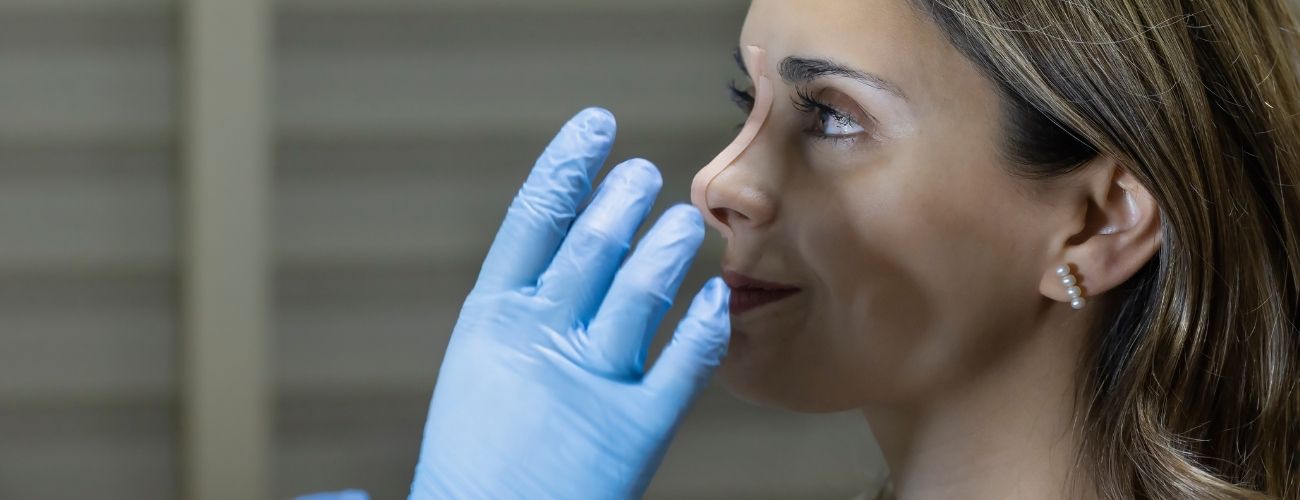
The Korean nose type is a specialized anatomical form evaluated within the discipline of Ethnic Rhinoplasty, typically characterized by a thick skin envelope, weak cartilage support, a low nasal dorsum, and insufficient projection. Common among individuals of East Asian origin, this morphology requires an approach opposite to standard reduction rhinoplasty: the depressed nasal bridge must be elevated and the broad, under-projected nasal tip must be structurally reinforced with grafts. The foundation of surgical treatment is not tissue removal, but reconstruction of missing skeletal support, balancing wide alar bases that disrupt facial harmony, and creating a defined yet natural profile under thick skin.
İçindekiler
What is the Korean nose type and what are its key features?
In patient evaluation, the first thing we assess is the existing anatomical inventory—what structural resources we truly have to work with. In Korean-type noses, we commonly see a delicate framework hidden under a strong, thick skin envelope. A useful analogy is a tent: the fabric (skin) is thick and heavy, but the poles (cartilage) meant to hold it up are weak. This mismatch directly affects how prominent and defined the nose appears on the face.
Key anatomical traits frequently seen in this nose type include:
- Thick skin envelope
- Low nasal dorsum
- Weak tip cartilages
- Wide alar base
- Short nasal length
- Flat nasal root (radix)
- Broad, under-defined nasal tip
- Retracted/hidden columella
- Underdeveloped septal cartilage
- Oily skin texture
These findings point to a surgical plan based on “adding/building” rather than “removing.” If we attempt to shrink the nose by resecting cartilage as in standard rhinoplasty, thick skin cannot contract properly, and the nose may heal into a rounded, shapeless form. Therefore, the strategy is almost always centered on strengthening the framework.
What is the core philosophy of Ethnic Rhinoplasty?
The most important responsibility in ethnic rhinoplasty is protecting the patient’s identity. The goal is not to “install” a Western-style nose that looks foreign on an Asian face. That approach often appears unnatural and can disrupt the person’s characteristic facial expression. Instead, the philosophy is to respect ethnic features while refining the nose into the best possible version that harmonizes with the rest of the face.
In Korean nose rhinoplasty, the aesthetic gains we aim for include:
- Facial harmony
- Natural appearance
- Balanced profile
- Clearer definition
- Cultural coherence
- Functional improvement
Balance is critical. Over-raising the dorsum can disrupt the relationship with the forehead and chin, and overly narrowing the nostrils can compromise breathing. For that reason, planning must be millimetric and individualized. The ideal outcome is not a nose that “announces” surgery, but one that looks as if it naturally belongs to that face.
How is a low nasal dorsum (bridge) elevated?
The most common complaint in Korean-type noses is a low nasal bridge (dorsum). This can reduce midface depth and weaken the profile. Patients frequently mention that glasses do not sit properly or that their nose appears “flat” in photos.
To correct this, the dorsum must be elevated—an augmentation approach. In the past, silicone implants were widely used. However, because the nose is a mobile area with delicate vascularity, foreign implants can carry long-term risks such as migration, infection, visibility due to thinning skin, or unnatural edges.
A more contemporary and biologically favorable strategy is autologous tissue use—using the patient’s own cartilage. This offers:
- Full biocompatibility
- Long-term stability
- Lower infection risk
- More natural feel and appearance
- No rejection risk
Cartilage (most often rib or ear) is carefully carved and placed to create a smooth dorsal contour. The result is a bridge that looks natural and feels like part of the patient’s own anatomy.
How are a drooping/under-projected tip and weak cartilage corrected?
The nasal tip is the “signature” of rhinoplasty. In Korean nasal anatomy, tip cartilages are typically soft and under-supported, and they cannot push the thick skin envelope outward to form a defined, elegant contour. The result is a rounded, flat, “unstructured” tip—what we describe as insufficient projection.
To correct this, we must think like engineers: if the existing framework cannot bear the load, we build new support columns. Strong cartilage grafts are used to lift and project the tip forward in a stable, long-lasting way.
Core techniques commonly used include:
- Septal extension graft
- Columellar strut graft
- Tip suture techniques
- Shield grafts
- Cap grafts
The Septal Extension Graft (SEG) is especially powerful: by extending the septal support toward the tip, it allows precise control of how much rotation and projection are created, and it helps prevent long-term tip drop—one of the biggest concerns in thick-skinned, weak-cartilage noses.
How is thick skin and limited definition managed?
In Korean nose rhinoplasty, the most challenging factor is often thick skin. Many patients describe the tip as “bulbous” or “ball-like.” Thick skin behaves like a blanket, masking fine cartilage work beneath it. If the underlying framework is not made sufficiently strong and well-defined, the skin will not “read” the refined shape.
This is why the primary solution is structural: the framework must be prominent and stable enough to tension the skin into a cleaner contour. In selected cases, limited soft-tissue maneuvers may also be performed, such as:
- Conservative subcutaneous fat reduction
- Selective release of fibrous attachments
- Careful thinning of the SMAS layer (when appropriate)
These steps must be done cautiously—over-thinning can compromise blood supply. The main weapon is always a strong skeletal design. Even if the nose becomes slightly larger in millimeters, improved definition often makes it look slimmer and more elegant to the eye.
Why is rib cartilage (costal cartilage) so important?
To build the strong framework required in East Asian rhinoplasty, we often need a significant amount of cartilage. Septal cartilage is frequently small or underdeveloped, and ear cartilage is soft and curved—often insufficient alone for robust dorsal augmentation or rigid tip support.
This is why the gold standard material is frequently the patient’s own rib cartilage. It provides abundant volume, strong resistance, and the ability to create both a smooth dorsum and a firm tip structure.
Advantages include:
- High strength and stability
- Large supply of graft material
- Excellent shapeability
- Complete biological compatibility
- Long-term structural support
- Lower infection risk compared to implants
Many patients worry about rib harvest, but with modern techniques it is generally well-tolerated. It is typically taken through a small incision (often ~2–3 cm) placed in a concealed inframammary crease. When performed properly, it does not destabilize the chest wall, and the scar often becomes subtle over time.
What can be done for wide alar bases (nostril width)?
After building the dorsum and tip, the next key area is the alar base. Genetically, Korean noses may have a wider and more laterally flared alar base, contributing to a flatter overall appearance.
A crucial nuance: once the tip is projected forward, the alar base often narrows naturally—like a tent base tightening when the central pole is raised. For this reason, the decision for alar base reduction is often made late in the procedure.
If the alar base remains wide relative to facial proportions, Alar Base Reduction may be performed. Principles include:
- Reducing base width conservatively
- Refining alar thickness when needed
- Ensuring symmetry
- Hiding scars in natural creases
Incisions are typically placed along the natural alar-facial groove so that once healed, scars are usually difficult to detect. When done conservatively, it is a finishing touch that can substantially improve nasal-facial balance without compromising airflow.
How does recovery progress and how is swelling managed?
Structural rhinoplasty—especially in thick-skinned patients—requires patience. Thick skin and lymphatic drainage patterns can prolong swelling compared to thin-skinned noses. Clear expectation-setting is therefore part of successful care.
Common recovery phases include:
- Splint period
- Taping period
- Early swelling phase
- Progressive refinement
- Final settling
A protective splint is typically worn for about 1 week. When it comes off, swelling is expected and normal. Social return is often possible around day 10. Coarse swelling may take about 3 months to significantly improve, while fine definition and full skin adaptation to the new framework often take around 1 year—sometimes up to 1.5 years in thicker skin.
Helpful recommendations often include:
- Sleeping with the head elevated
- Reducing salt intake
- Performing surgeon-directed massage if advised
- Sun protection
- Staying well-hydrated
Morning swelling that improves during the day is a normal part of the recovery pattern in many patients.
How should technique choice and scarring be approached?
Whether to use open or closed rhinoplasty depends on the case requirements. In Korean-type noses, extensive grafting, framework building, and symmetry control are often needed, which can make open rhinoplasty advantageous due to superior visibility and precision.
Scarring is a common concern, but the columellar incision in open rhinoplasty—when closed properly—typically becomes faint over time.
Factors influencing technique selection include:
- Severity of deformity
- Amount and type of grafting required
- Skin thickness
- Revision status
- Patient goals
In suitable cases with less complex needs, closed techniques may also be appropriate. The key is choosing the approach that allows the surgeon to deliver the most stable, natural result.
What about long-term stability and permanence?
True success in rhinoplasty is judged not only at 1 month but at 5–10 years. Structural techniques and autologous grafts offer a major advantage in long-term stability for Korean-type noses.
If insufficient support is used—especially when relying on weak native cartilage or placing an implant on an unstable framework—gravity and thick skin pressure can cause changes over time. In contrast, a strong structure built with costal cartilage can maintain both shape and function for years.
Long-term gains typically include:
- Stable contour preservation
- Better tissue integrity
- Improved nasal airflow when addressed properly
- Greater resistance to age-related tip descent

Prof. Dr. Murat Songu – Burun Estetiği (Rinoplasti) Uzmanı
Prof. Dr. Murat Songu, 1976 yılında İzmir’de doğmuş, tıp eğitimini Ege Üniversitesi Tıp Fakültesi’nde tamamladıktan sonra Celal Bayar Üniversitesi Kulak Burun Boğaz Anabilim Dalı’nda uzmanlık eğitimini tamamlamıştır. 2005–2006 yıllarında Fransa’nın Bordeaux kentinde Prof. Vincent Darrouzet ve Dr. Guy Lacher gibi rinoloji alanının önde gelen cerrahlarıyla çalışarak rinoplasti, fonksiyonel burun cerrahisi ve kafa tabanı cerrahisi üzerine ileri eğitim almıştır.
Burun estetiğinde doğal görünüm, nefes fonksiyonunun korunması ve yüz estetiği dengesini ön planda tutan Prof. Dr. Songu, açık teknik rinoplasti, piezo (ultrasonik) rinoplasti, revizyon rinoplasti, burun ucu estetiği ve fonksiyonel septorinoplasti operasyonlarında ulusal ve uluslararası düzeyde tanınan bir cerrahtır. Yurt içi ve yurt dışında çok sayıda rinoplasti kongresinde eğitici ve konuşmacı olarak yer almış; yüz estetiği ve burun cerrahisinde modern tekniklerin yaygınlaşmasına öncülük etmiştir.
100’den fazla bilimsel yayını, kitap bölümü yazarlıkları ve 1700’ü aşkın uluslararası atfıyla rinoplasti alanında Türkiye’nin en saygın akademisyenlerinden biri olan Prof. Dr. Murat Songu, doğal, yüzle uyumlu ve fonksiyonel sonuçlar hedefleyen cerrahi yaklaşımıyla hem bilimsel hem estetik başarıları bir araya getirmektedir.